There is a dress code that sits somewhere between a power suit and a pair of jeans, and for the past three decades it has quietly become the dominant aesthetic of modern professional life. It's called business casual - and while the term might conjure images of beige Dockers and uninspired button-downs, the reality of what business casual has become is far more interesting than that.
From Silicon Valley founders who turned hoodies into a uniform of power, to political figures who redefined what professional dressing looked like for women, to the fashion world's own take on polished-but-relaxed dressing - business casual has a richer, more influential history than almost anyone gives it credit for. Here's the full story, including the icons who shaped it.
Where Did Business Casual Come From?
The origins of business casual are more colourful than you might expect. The story begins not in a corporate boardroom, but in 1960s Hawaii.
In 1966, the Hawaiian Fashion Guild launched what it called "Aloha Friday" - a campaign encouraging offices to allow employees to wear Hawaiian shirts on Fridays, in support of the local garment industry and as a concession to the island's year-round heat. The idea caught on, spread to the mainland United States, and gradually evolved into the more broadly understood concept of Casual Friday - a weekly reprieve from the rigid suit-and-tie culture that had dominated office life for decades.
The real tipping point came in 1992, when Levi Strauss & Co. sent an eight-page brochure called "A Guide to Casual Businesswear" to 25,000 human resource managers across the United States. The brochure - which, unsurprisingly, featured a great deal of Dockers khakis - essentially defined the business casual dress code for a generation and gave HR departments across the country a template to work from. It was a masterstroke of corporate marketing that also happened to change the way the world dressed for work.
Meanwhile, in Silicon Valley, something different was happening. The tech industry's young founders and innovators were simply refusing to conform to traditional office dress codes at all - and as those companies grew into some of the most powerful in the world, their approach to dressing began to carry enormous cultural weight.
The Icons Who Pioneered Business Casual
Steve Jobs: The Black Turtleneck That Changed Everything
Few people have done more to shape the modern understanding of business casual than Steve Jobs - and his contribution was to make the concept almost irrelevant by replacing it with something even more deliberate: the personal uniform.
Jobs wore a black Issey Miyake turtleneck, Levi's 501 jeans, and New Balance sneakers every single day. By pairing the casualness of jeans and sneakers with the clean, considered quality of a designer turtleneck, he created something that was simultaneously relaxed and completely authoritative. It was business casual distilled to its absolute essence - and it sent a message that the rules of professional dressing were his to write, not inherit. The image became so iconic that it permanently shifted the conversation about what powerful people were allowed to wear.
Mark Zuckerberg: The Hoodie as Power Statement
Where Steve Jobs chose minimalist designer pieces, Mark Zuckerberg went one step further into studied casualness. The grey t-shirt, dark jeans, and occasional hoodie that became his uniform were so consistent and so deliberate that they became a statement in themselves - proof that in Silicon Valley, the person with the most power was the one least concerned with performing that power through their clothing.
Zuckerberg later revealed that his signature grey t-shirts are actually Brunello Cucinelli - an Italian luxury brand known for impeccable quality and extremely quiet branding. That detail says everything about what modern business casual has become: the most expensive version of looking like you didn't try.
Barack Obama: Suits Worn Like Business Casual
Barack Obama's approach to professional dressing was different from the tech world's studied casualness, but equally influential. His signature grey and blue suits - worn with a relaxed ease that made them feel approachable rather than formal - demonstrated that even the most traditional professional garment could be worn in a way that felt human and accessible.
Obama's consistent, unfussy approach to dressing communicated competence and calm without rigidity - precisely the qualities that define the best business casual dressing, whatever form it takes.
Michelle Obama: Redefining Professional Dressing for Women
While much of business casual's history is dominated by male figures, Michelle Obama's influence on professional women's dressing was transformative. Her approach - chic sheath dresses, bold colors, mixing high-street pieces with designer labels, showing her famously toned arms when the occasion allowed - directly challenged the conservative pantsuit tradition that had long defined power dressing for women.
She showed that professional dressing for women didn't have to be a costume or a uniform - that it could reflect personality, confidence, and genuine style while remaining entirely appropriate for the world's most high-profile environments.
Victoria Beckham: The Fashion Industry’s Take on Business Casual
In the fashion world, no one has done more to define a high-fashion version of business casual than Victoria Beckham. Her personal style - sharply tailored trousers, clean-lined blazers, minimal accessories, understated color palettes - is the template for what elevated business casual looks like when fashion takes it seriously.
What makes Beckham's approach so influential is its consistency. She proved that you could look impeccably polished and completely professional while remaining firmly in the territory of business casual - and that the key was in the quality of the tailoring and the restraint of the styling rather than the formality of the garments themselves. And now she has released a makeup line. She's unstoppable!
The Rolling Stones and the Peacock Revolution
Long before Silicon Valley rewrote the rules of office dressing, the counterculture of the 1960s was already challenging what clothing was allowed to communicate. Celebrities including Mick Jagger, Jimi Hendrix, and The Beatles promoted a more casual, egalitarian philosophy of dressing that began to filter into professional life - making clothing more expressive, more colorful, and less rigidly defined by class and convention. This so-called "peacock revolution" planted seeds that would eventually flower into the business casual culture we know today.
What Business Casual Looks Like Now
Business casual in 2026 is a far more sophisticated concept than its khaki-and-Dockers origins would suggest. The dress code has been claimed, elevated, and entirely reimagined by a generation that grew up watching tech billionaires in hoodies and fashion editors in impeccable tailoring - and the result is a look that is genuinely interesting.
The modern business casual wardrobe is built around a few key principles:
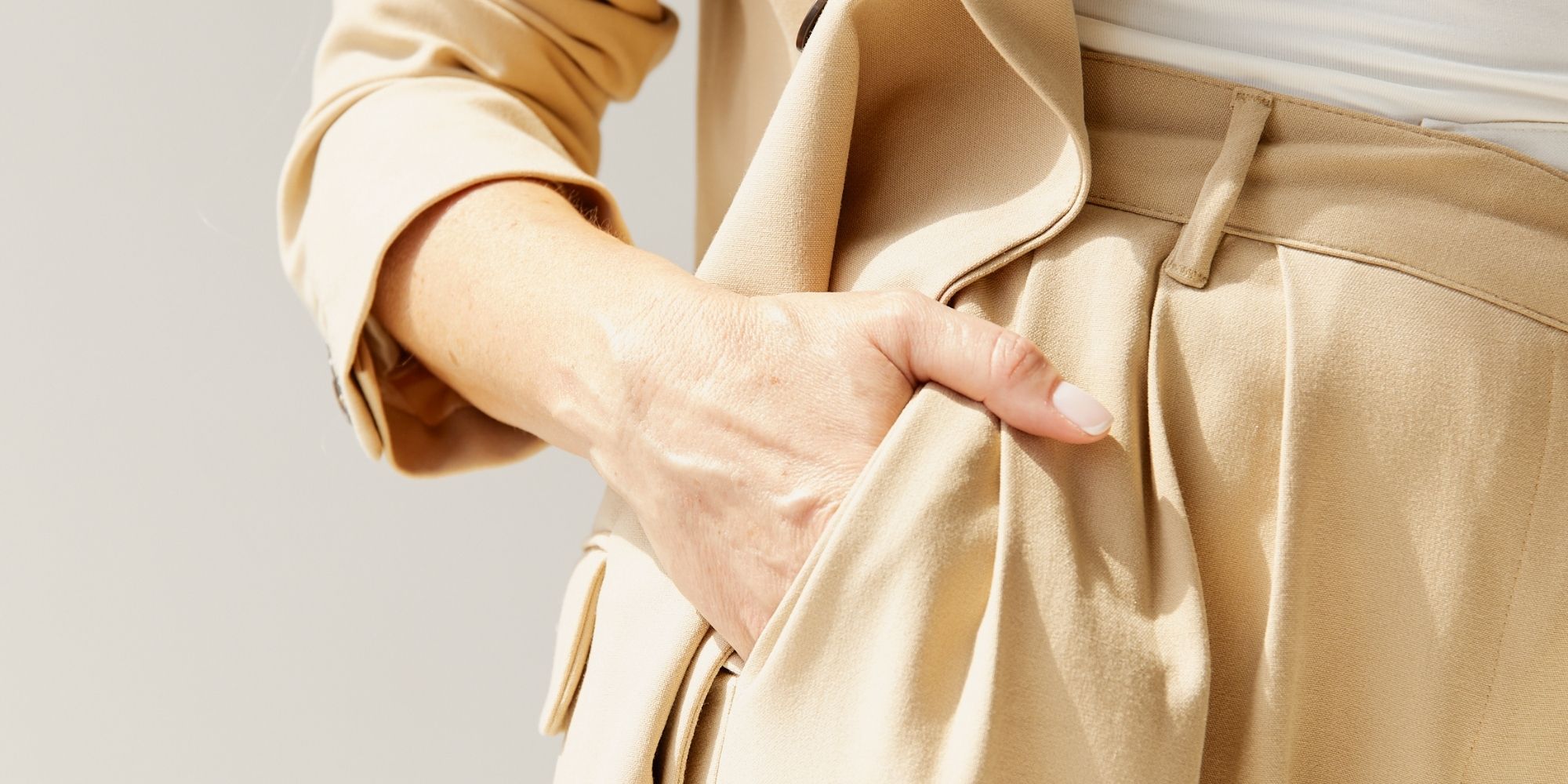
Tailoring without formality. Wide-leg trousers, beautifully cut blazers, and structured coats worn in relaxed, unconstructed ways. The garments are polished; the energy is not.
Quality over decoration. The most influential business casual dressing right now prioritizes exceptional fabric and construction over logos, embellishment, or visible branding. This is the Brunello Cucinelli grey t-shirt approach - spending money on things that don't announce themselves.
Elevated basics. A perfect white shirt, a fine-knit polo, a cashmere roll-neck - the building blocks of business casual that never date and always look considered.
Sneakers as standard. The normalisation of sneakers with tailored clothing is one of the defining shifts in business casual dressing of the past decade, and it shows no sign of reversing. The right pair of sneakers with a sharp blazer and wide-leg trousers is one of the most reliably stylish combinations in any wardrobe.
Minimal accessories. In business casual dressing, less is almost always more. A single well-chosen watch, a structured bag, understated jewellery - the accessories of someone who has thought carefully about what they're wearing without making a performance of it.
Why Business Casual Has Won
The dominance of business casual isn't accidental. It reflects a genuine and lasting shift in what professional life looks like, what power dressing communicates, and how the most influential people in the world have chosen to present themselves.
The suit didn't disappear because people stopped caring about how they looked at work. It evolved - into something that said the same things (capability, authority, intention) while adding new ones: creativity, confidence, individuality. The most powerful people in the world stopped dressing like they were trying to look powerful, and the rest of us took note.
Business casual won because it told a better story. And the celebrities and icons who pioneered it - from Steve Jobs in his turtleneck to Victoria Beckham in her perfectly cut trousers - showed the world exactly what that story could look like.

Grace leads the editorial vision behind 405Threads’ coverage of celebrity style, fashion trends, and wardrobe essentials. With a lifelong passion for fashion, a diverse cultural background, and expertise in trend forecasting, celebrity fashion analysis, and style curation, she brings readers a global perspective that remains accessible and relevant to everyday life. Grace believes fashion is about more than following trends – it’s about self-expression, confidence, and individuality.